How Staff Engineer Scope Differs From Senior at AI Startups
Staff engineers shape direction across teams while seniors execute within their domain.

A senior engineer builds a great RAG system for their team. A staff engineer notices that three product teams each built their own retrieval layer, so they propose a unified retrieval service and get all three teams to adopt it. The senior engineer shipped a feature. The staff engineer produced organizational alignment, and that difference is the entire subject of this piece. At AI startups, moving from senior to staff changes what you are hired to produce: senior engineers are hired for excellent execution on a scoped problem, staff engineers are hired to identify which problems are worth solving.
That shift appears first as a change in judgment and accountability, before it appears in title or compensation. Senior engineers are judged by the quality and speed of their execution inside a team. Staff engineers are judged by how they shape direction across teams, reduce friction between systems that were never designed to talk to each other, and connect specific engineering decisions to business outcomes the company actually tracks. The habits that made someone an excellent senior engineer, personally solving every hard problem and optimizing for the win in front of them, become a ceiling at staff level if an engineer holds onto them too tightly. Staff scope requires giving up some of the satisfaction of personal authorship in exchange for influence that outlives any single sprint.
Nothing about this makes senior engineering a lesser craft. It means the two levels are solving different kinds of problems, and treating the jump as "more of the same, but better" misreads what promotion committees are actually trying to measure. The rest of this piece works through that operating-model shift one layer at a time: the rubric committees use, the week-to-week texture of the job, why AI startups make the distinction sharper than it is at established companies, and what the shift means for interviews, archetypes, and pay.
What changes across the five dimensions promotion committees measure
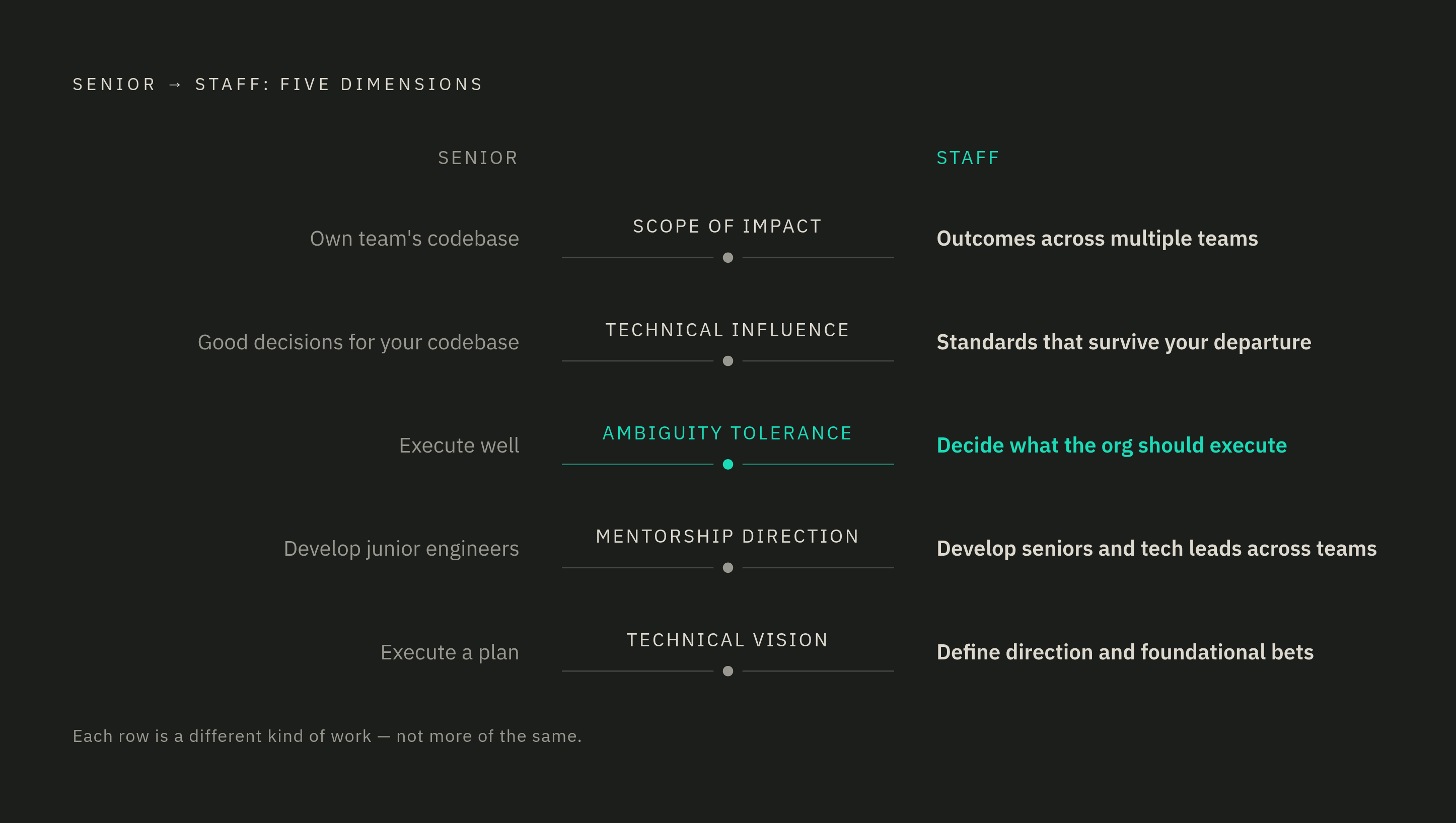
Promotion committees evaluate the senior-to-staff jump across five dimensions, and each one marks a distinct kind of change, not just a bigger version of what came before.
Scope of impact moves from owning execution quality within one product surface or domain to owning outcomes across multiple teams. A senior engineer's success is measurable inside their own codebase. A staff engineer's success is measurable in whether other teams' outcomes improved because of a decision that engineer made.
Technical influence moves from making good decisions for your own team's codebase to codifying those decisions into standards that other teams adopt. The real test of staff-level technical influence is durability: do the standards survive the engineer's departure, or do they quietly dissolve the moment that person moves on?
Ambiguity tolerance moves from being trusted to execute well to being trusted to decide what the organization should execute. Senior engineers answer "how do we build this." Staff engineers answer "should we be building this, and what happens if we don't."
Mentorship direction moves from developing junior engineers to developing senior engineers, and to establishing tech leads across multiple teams. The output of staff-level mentorship is leadership capacity spread across the organization, not the skill growth of any one person.
Technical vision moves from executing a plan to defining the direction a plan should take. At an AI startup, that frequently means making a foundational architectural bet, on a model-serving approach or a retrieval strategy, well before the cost of getting it wrong becomes visible to anyone else in the company.
How the day-to-day week looks different at staff level
The clearest real-time signal of which level someone is operating at is the ratio of time spent in the editor versus time spent on architecture, design review, and coordination across teams. Senior engineers spend most of a working week writing, reviewing, and shipping features inside their own team. Staff engineers spend less time writing code and considerably more time on technical strategy documents, design reviews, and unblocking teams that aren't their own.
Several activities intensify once an engineer crosses into staff scope: running design reviews for components that multiple teams depend on, setting engineering standards meant to apply company-wide, coordinating incident response across services owned by different groups, and driving migration or deprecation programs that touch infrastructure nobody wants to touch alone. Staff engineers still write production code, but usually for the hardest or highest-risk piece of a system, or to prove out a pattern other teams are expected to follow, rather than to move a velocity metric for their own team.
Cross-functional meetings grow accordingly. Staff engineers spend regular time aligning with product management, security, and operations on technical direction, and regular contact with directors and VPs becomes part of the job rather than an occasional event triggered by a crisis. This ratio shift, less editor time, more design and coordination time, looks roughly similar whether the company is a ten-person startup or a ten-thousand-person public company. What differs sharply is the context that surrounds it. That context is where AI startups start to pull away from the established pattern.
How AI startups distort the leveling ladder
At large, established tech companies, staff-level criteria are written down in numbered band definitions that an engineer can study, compare themselves against, and use to build a promotion case. At AI startups, none of that scaffolding exists in the same form. Titles are loose, scope changes every quarter as the product and the team reorganize around it, and it is entirely possible for a senior engineer to be doing staff-level work for two straight quarters without the title, the pay, or the authority that should accompany it.
That absence of a documented ladder changes the question an engineer should be asking. "Am I senior enough yet?" assumes a ladder that will eventually tell you where you stand. The more useful question at a startup is "Am I extending my influence beyond my own team?" because that is the actual distinction the company cares about, whether or not its internal leveling document says so.
Titles at early-stage AI startups can be misleading in a specific way. A Principal Engineer at a Series A company with 30 employees might be the most senior individual contributor on the team, might be a founding engineer, and might be the only person with real production AI experience, and their actual scope is still "make this product work," not "define company-wide strategy," because the company doesn't have a company-wide strategy stable enough yet to define against. At most VC-backed startups, Staff is the first level that carries company-wide impact: ownership of a major surface area with limited oversight. Principal typically doesn't appear as a meaningful layer until Series C or later, once the engineering organization has grown large enough to need that additional rung.
AI engineering sharpens this further. Traditional software engineering has decades of documented staff-level playbooks: what a staff backend engineer does, what a staff infrastructure engineer owns, what good looks like at that scope. AI engineering does not have that history yet. That means figuring out what staff-level AI engineering looks like at a given company is itself a staff-level contribution, not a prerequisite someone has to clear before being allowed to do staff-level work. The absence of a map is a structural feature of a young discipline, not a sign that startups are disorganized, and it makes the operating-model shift more visible, and more consequential, than it would be in a field with an established rulebook.
The three archetypes staff AI engineers at startups map to
Staff AI engineers at startups tend to cluster into three recognizable archetypes, and figuring out which one a specific role is actually hiring for changes what should appear on a resume and what gets emphasized in an interview.
The Platform Builder creates shared infrastructure that every AI team in the company depends on: evaluation frameworks, prompt management systems, model routing layers. Engineers in this mode are often handed ownership of a substantial piece of core infrastructure, sometimes the entire MLOps pipeline, sometimes the foundational model-serving architecture the rest of the product sits on.
The Cross-Team Architect doesn't build infrastructure directly. Instead, this archetype solves a specific cross-team problem that nobody else is positioned to own. The retrieval example from earlier is the clearest version of this: three teams independently build incompatible retrieval pipelines, so the Cross-Team Architect proposes a unified approach, writes the design document, secures buy-in from each team, and leads the migration. The authority here comes from technical credibility, not from a management title.
The Technical Strategist works closest to company leadership: they evaluate emerging technologies, run proof-of-concept experiments, and recommend the bets the company should make. This archetype answers questions like whether to build or buy an evaluation platform, with analysis that ties technical trade-offs directly to business outcomes. At a small AI startup, the Technical Strategist is often an experienced outside hire brought in for a specific foundational problem, building an MLOps platform from the ground up, rather than someone who grew into the role from inside the company.
Most staff AI engineers blend two of these archetypes rather than embodying one in pure form, and the mix shifts as the startup scales. Recognizing which blend a role is actually asking for tells a candidate what the interview will probe, what the week-to-week work will feel like, and how much of the job's value is tied to equity that depends on the company's trajectory.
AI coding tools and the senior-to-staff distinction
AI coding assistance is compressing the implementation gap between senior and staff engineers, and that compression pushes the real differentiator further toward judgment: knowing which problems are worth solving, and designing systems that hold up once they're built. This is a faster, structurally different shift than the productivity tools that came before it, because it compresses the exact skill, fast, high-quality implementation, that used to separate a strong senior engineer from an average one.
"Writes great code" is a weaker signal of seniority when a capable generalist with good prompting instincts can close much of that output gap using the same tools. "Identifies the right problems and sets standards other teams follow" doesn't compress the same way, because no coding assistant decides which three teams should be using one retrieval service instead of three. Software development in 2026 is moving toward a model where human expertise concentrates on defining which problems are worth solving and governing the systems that solve them, which is structurally identical to what staff-level scope has always demanded. What's changed is timing: that pressure now arrives earlier in an engineer's career, before they've necessarily had the chance to build the organizational judgment the role requires.
That leaves an open tension. If coding agents keep compressing implementation, the staff-level value proposition, organizational scope and architectural judgment, may become the only durable advantage an individual contributor has left. It is the hardest thing to teach directly, the hardest thing to hire for with confidence, and the hardest thing to demonstrate convincingly in a four-hour interview loop. The tools make staff-level skill the main thing left to evaluate.
Distinguishing senior from staff candidates at AI-native companies
Leveling decisions at AI-native companies rest on evidence of cross-team architectural ownership, not on technical correctness by itself, and the interview process is built to surface exactly that distinction rather than to confirm that a candidate can write correct code.
A common pattern in these interviews is asking a candidate to describe a specific cross-team technical decision they owned. A senior-level answer typically describes a model or pipeline improvement scoped to their own team. A genuine staff-level answer describes a platform-wide architectural decision that changed how engineers outside that person's team actually work, backed by documentation detailed enough to count as a formal design proposal and sign-off from stakeholders across functions, not just from the candidate's manager.
System design rounds carry real weight in these decisions because they reveal whether a candidate thinks architecturally and at scale, not merely whether they can produce a correct design on a whiteboard. Interviewers probe for how a candidate reasons about failure modes, cost growth, and shifting workloads as the design evolves under pressure. At companies running large-scale model serving, these prompts are infrastructure-specific and demand real numbers: memory capacity, throughput, cache sizing, not an abstract gesture toward "scaling horizontally." The ability to engage with constraints specific to large language model infrastructure is what separates candidates in these rounds, not generic familiarity with distributed systems.
The founding engineer variant of the scope gap
The pay gap between senior and staff at AI-native companies is wide enough that the operating-model shift appears directly in compensation structure, not only in title. Equity at early-stage startups widens that gap further and makes it considerably more variable than a base salary comparison alone would suggest.
Total compensation for Staff Engineer roles often reaches into the mid-to-high hundreds of thousands at larger, publicly traded tech companies. Well-funded startups typically offer a wide range at the same level, depending heavily on how liquid the equity actually is. Principal Engineer compensation runs higher still, and Principal openings are considerably rarer, with roughly one Principal opening for every three to four Staff openings. At AI-native startups specifically, options attached to a staff offer may end up worth nothing or worth a multiple of base salary, and that spread is wider than at established companies. Accepting a staff-level offer at an early-stage AI startup is a bet on the company's trajectory as much as it is a compensation negotiation.
The founding engineer role is where this blurs most sharply. AI startups need staff-caliber engineers who can ship product at startup speed while also building AI systems that hold up once they hit production, and companies pay for that combination in ownership as much as in salary. A founding engineer is often setting technical direction, making foundational architectural bets, and shaping the engineering culture from scratch, all staff-level contributions, while also personally writing a large share of the production code, which is senior-level execution. The role asks one person to operate at both levels at once, and the equity stake reflects that the company is betting its early technical foundation on them.