When to Leave a Company to Make the Staff Jump
Organizational structure, not skill gaps, blocks most senior engineers from reaching Staff roles.

Most senior engineers who stall before Staff don't have a skills problem. They have an org design problem, and it's one they cannot fix from inside the org that created it. The common model goes: do excellent work, get recognized, get promoted. That model only works if the company's ladder has a real Staff rung built into it, and if that rung isn't already filled by somebody else. When either condition is missing, the model doesn't slow down, it stops entirely, no matter how good the work is.
This produces a counterintuitive result. Staying and working harder feels like the safe, patient choice. It's often the riskier one, because it bets an entire career timeline on an org structure changing to accommodate you, on a schedule you don't control and can't see. The goal here is to give engineers a way to tell two very different situations apart: "I haven't earned this yet" and "this company cannot grant this, structurally, regardless of what I earn." Those require opposite responses, and confusing them is the single most expensive mistake available at this career stage.
What makes a Staff role structurally impossible
Some companies cannot produce a Staff promotion no matter how strong the candidate is, and that condition is identifiable well before an engineer sinks another year into waiting for it to change.
Start with headcount. Small companies typically carry one Staff role and one CTO, full stop. There's no scope for multiple Staff-level ICs to operate at once, because the surface area of the problem doesn't support it. In that setup, "Staff" is a seat occupied by one person, not a level that engineers rise into. Cadence's 2026 retention data names this directly: the honest fix is a parallel IC track with real scope and real compensation deltas attached to it, not a title handed out for morale. Where that parallel track doesn't exist, the ceiling is real and no amount of output removes it.
A second condition is the absence of a defined ladder. Plenty of Series A and B companies never formalized one. "Staff" floats around as an idea in conversation, but nobody has written down what it actually requires. A 2026 engineering careers guide documents this exact pattern: engineers hired as "Senior Engineer" discover years later that there's no principal or staff track on paper, no criteria they could point to, and no timeline anyone will commit to. Without documented criteria, there's nothing to work toward, only a hope that someone eventually decides to invent a process.
A third condition is a political promotion process. When advancement to Staff tracks visibility and proximity to leadership instead of published scope milestones, that process is a tournament, and most entrants lose regardless of how much they've shipped.
A fourth condition sits with the manager. A manager who can't describe the next promotion in concrete milestones, who keeps an engineer away from leadership visibility, or who consistently under-levels that engineer's work in calibration isn't neutral. That manager is the ceiling. There's a direct test for this: ask, "What specifically would I need to deliver in the next two quarters to be promoted?" A manager who's actually equipped to promote someone answers with three or four concrete things. A manager who can't will answer with adjectives, words like "leadership" or "ownership" that carry no measurable criteria.
One objection deserves a direct answer. Some engineers will say patience is the whole strategy, that great work gets recognized eventually. At companies without any of the four conditions above, that can be true. At companies with one or more of them, patience is a decision to keep absorbing the cost of a system that was never going to produce the outcome in question.
The signals that your current role has already stopped compounding
A rough quarter and a genuine growth ceiling look similar from the inside, and the way to tell them apart is behavioral.
A handful of signals appear cleanly in daily work. If every code review comment is predictable before it lands, review has stopped teaching anything. That's review theater, not growth. If six months have passed without a new mental model, not a new library, but an actual new way of thinking about a category of problem, debt is accumulating against future competitiveness in a market that moves fast enough to punish standing still. If the engineer is the most senior person in every room and nobody pushes back, that absence of friction is a career emergency, because ideas that never get challenged ship weaker than ideas that get stress-tested before launch.
Scope matters just as much as substance. Healthy careers look like a staircase, step after step of widening responsibility. If output has clearly improved over the past year but the surface area of responsibility hasn't moved at all, the org is failing to convert that growth into leverage. And if the tech stack itself is frozen, no new primitives, no migrations, nothing resembling AI work landing in production, every quarter that passes makes the engineer a weaker candidate in a market that's actively hiring for the opposite. A 2026 engineering career guide puts a number on this: one of these signals alone is normal, nothing to panic over. Three or more, sustained across six months, means the role has become too small for the person in it.
The stack signal carries the most weight of all of them, because it maps directly onto what the job market is paying for right now. Companies hiring aggressively are explicitly looking for engineers who've shipped to production with agent frameworks, LLM observability, eval pipelines, retrieval systems, and inference infrastructure. A frozen codebase doesn't just feel stale. It accumulates skills debt, and the market charges interest on that debt the moment an engineer tries to move.
There's a quieter signal too: mission drift. When senior ICs stop arguing about architecture in PR review, they've usually already checked out mentally, well before they've admitted it to themselves. Shorter, more transactional PR descriptions, with fewer notes like "I considered X but went with Y because," signal this withdrawal. Industry retention research identifies this kind of behavioral withdrawal as a leading indicator, typically appearing four to six months before someone actually decides to leave.
Run one test to tie all of this together: if the next two years looked exactly like the last two, would the engineer be meaningfully more valuable to the outside labor market at the end of it? If the honest answer is "not really," that's the signal that matters most.
Spotting a company that won't promote you
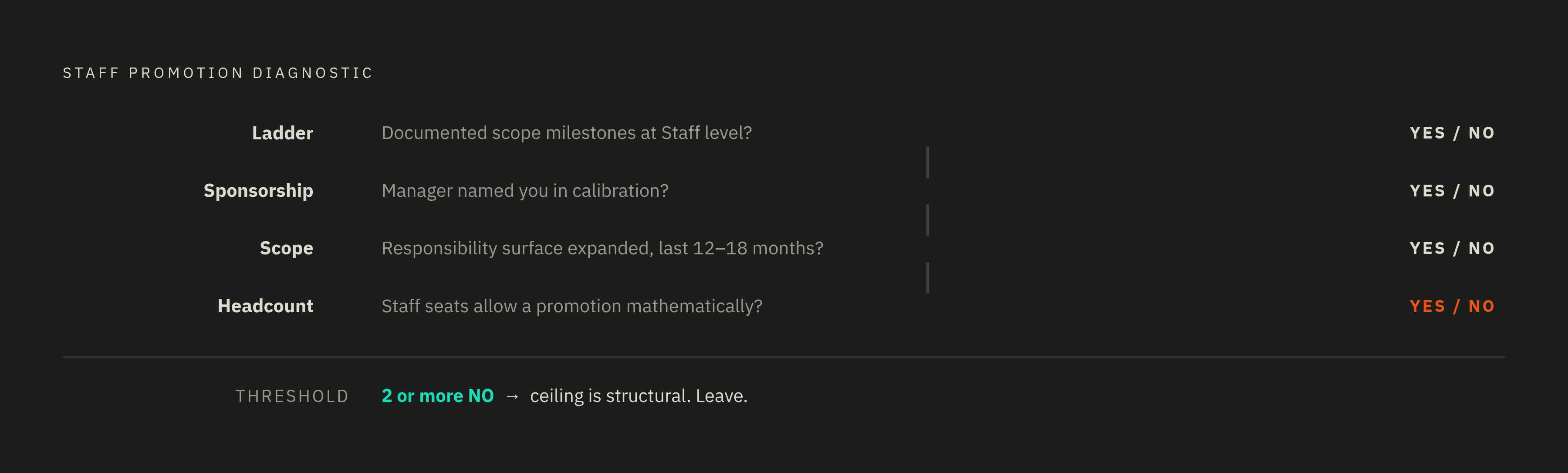
Whether a company will actually promote someone to Staff is testable. It doesn't require reading tea leaves, just running a small number of direct experiments before deciding to leave.
The first is the ladder test. Does a documented engineering ladder exist with observable, specific criteria at the Staff level, things like a system owned outright, a hire led end to end, an incident run solo, a roadmap authored? Not adjectives like "demonstrates leadership," but scope milestones that can be checked off. If no such ladder exists, promotion criteria will get invented around the engineer after the fact, which makes the outcome political rather than earned.
The second is the manager sponsorship test. Has the manager named this engineer in calibration? Advocated for them in compensation discussions? Built visibility for their work in front of leadership? A manager who can't answer the two-quarter milestone question and hasn't actively sponsored the engineer isn't neutral ground. That manager is the ceiling, and the ceiling doesn't move without them choosing to move it. A 2026 engineering careers guide documents a related pattern: engineers who raised their growth prospects directly with their manager and got silence, or a non-answer, belong in the "structural, not fixable" category.
The third is the scope test. Has the surface area of responsibility actually expanded over the last 12 to 18 months, or has strong output just been rewarded with the same box as before? If growth isn't converting into ownership, that's an org design failure, and org design doesn't change because one engineer tries harder.
The fourth is the headcount math test. Count the Staff-and-above ICs in the org. Then count the senior ICs who want that level. If the ratio makes two people's promotion mathematically impossible, leaving is the correct reading of the math in front of you.
When these tests come back clean, when a ladder exists, a manager is actively sponsoring the engineer, scope is expanding, and the headcount math isn't closed off, staying is the right call. The gap in that case is performance, so leaving before the promotion lands would mean walking away from value already in motion. When two or more tests come back negative, and stay negative even after a direct conversation naming the gap explicitly, the ceiling is structural and waiting longer won't change it. Cadence's 2026 retention data frames the fix companies should be making: a parallel IC track with real scope and real comp deltas. Where that doesn't exist, the engineer already has the answer.
When the equity and timing math changes the calculation
Even with a clear structural diagnosis pointing toward the exit, vesting and timing are real variables that can shift the rational exit date by months. Ignoring that math is expensive.
The calculation runs like this: if a meaningful equity event sits within six months, absorbing a structural ceiling for that window while building skills independently can be a defensible choice. The comp math behind that decision is legitimate. If the event is more than six months out and the structural signals are already clear, using the equity as a reason to stay is a rationalization, not math.
There's also a "ship it first" case: someone weeks away from a launch worth naming on a resume often gets more value from finishing it than from leaving a month earlier. Staff-level candidates get evaluated on what they've delivered end to end, and walking away before that outcome is documented costs something real in the next interview process.
Compensation drift adds its own cost to waiting. A senior engineer whose total comp hasn't been benchmarked in 18 months is likely sitting meaningfully below current market rates. The cost of staying is comp drag compounding on top of the delayed title, month after month. A 2026 engineering careers guide makes the retention-offer dynamic explicit: if a company only finds budget once an outside offer appears, that company was aware of the gap all along and chose to let it persist. The counter-offer resolves the symptom. The counter-offer leaves the underlying dynamic that created the gap unchanged.
The honest frame is this: equity and timing math is a reason to optimize when to leave, not a reason to delay deciding whether to leave. Those are two separate variables, and collapsing them into one is how good engineers end up staying three years longer than the situation ever justified.
What a move unlocks at the Staff level
A move timed correctly against these signals delivers more than a new title. It delivers the scope, the stack exposure, and the comp reset that staying would have put off indefinitely.
A Staff title only means something if it arrives with real scope attached: architecture ownership, cross-team technical leadership, real influence over roadmap and hiring decisions. A Staff title at a company with a broken ladder is just a label, and the market reads the difference without much effort.
Company size and stage matter when picking a target. The founding engineer market in 2026 is tight. A founding engineer hiring report documents that candidates with genuine zero-to-one experience at venture-backed startups are rare, that passive outreach is required for nearly every search, and that comp bands rose 12 to 18 percent year over year in 2025. An engineer with a credible founding or early-stage track record walks into that market from a position of real leverage. On the other end, larger companies with documented Staff-plus ladders, where criteria are public and calibration is a known process, are the right target for an engineer whose priority is title clarity over equity upside.
Hiring speed matters too, and it's practical, not abstract. The same 2026 founding engineer hiring report finds that founders who move to interview within five business days of first contact close candidates at a substantially higher rate than those running three-to-four week processes. An engineer running a timed exit should prioritize companies whose process can actually close before a competing offer forces a decision under pressure.
What does this kind of move signal to the market? Leaving a company where structural conditions made Staff impossible is a legible, defensible career move, as long as the engineer can name precisely what they shipped, what scope they carried, and what they're pursuing next. The story carries more weight than the tenure length ever will.
Running the exit process without sacrificing your current leverage
The most common mistake after deciding to leave is running a slow, visible, or poorly sequenced process, one that either tips off the current employer too early or forces a rushed decision the moment an offer lands.
Sequencing comes first. Finalize the decision internally before starting anything externally. An engineer who's only half-decided interviews half-heartedly and tends to accept the first offer out of anxiety rather than the best offer chosen from real options.
Three things should be ready before the first conversation with anyone else. A specific account of what was shipped end to end, with a measurable outcome that holds up under follow-up questions, a story with a result, not a list of technologies used. A clear, clean articulation of why the current situation is a structural ceiling rather than a performance problem, since interviewers at strong companies can tell the difference, and framing it well signals real self-awareness. And a target comp range built from current market data rather than the last raise received, since comp drift is real and the gap between current pay and what the market will offer is often larger than expected.
Counter-offers deserve a clear-eyed read. If the current employer produces a retention offer the moment departure is signaled, a 2026 engineering careers guide is direct about the outcome: only 30% of engineers who accept a counter-offer are still there six months later. The counter-offer resolves the symptom, not the structural problem that caused the engineer to look elsewhere. A company that only benchmarks pay once it's forced to will revert to old habits soon enough, and the counter-offer itself is information about how that company operates, not a reason to reconsider whatever structural ceiling triggered the search.
Reputation is the one asset worth protecting through all of it, and an engineer who leaves cleanly, documents their systems, closes out their commitments, and frames the departure professionally, carries a network forward into the next chapter. The founding engineer market runs heavily on referrals, and the relationship with a current team remains a long-term asset even when that company was never going to be the place the Staff jump happened.