Staff Engineer Archetypes at Startups vs. Big Tech
Organizational structure, not job title, determines what a Staff Engineer role actually entails.

Staff Engineer archetypes at startups and big tech describe different jobs. How a company is set up shapes the work it has to offer, so the archetype is a better guide to that work than the title. Fonzi’s research into engineering org composition across AI startups and scale-ups helps decode that difference before an offer becomes a career commitment.
Why the same title describes four different jobs
Will Larson’s framework names four Staff Engineer archetypes, namely Tech Lead, Architect, Solver, and Right Hand. The Tech Lead guides one team or a cluster of teams and is the most common archetype. The Architect owns technical direction and quality in a critical domain that remains central to the business. The Solver takes on unusually hard problems, resolves them, and moves on. The Right Hand extends an executive’s attention by borrowing that executive’s scope and authority.
These are not four rungs on a ladder. Each describes a different relationship to code, teams, and decision-making power. A Solver may be most useful when stepping in to fix a problem, while a Right Hand relies on a working relationship with an executive. Treating both as the same job hides what each needs to succeed.
How company structure determines which archetypes can actually exist
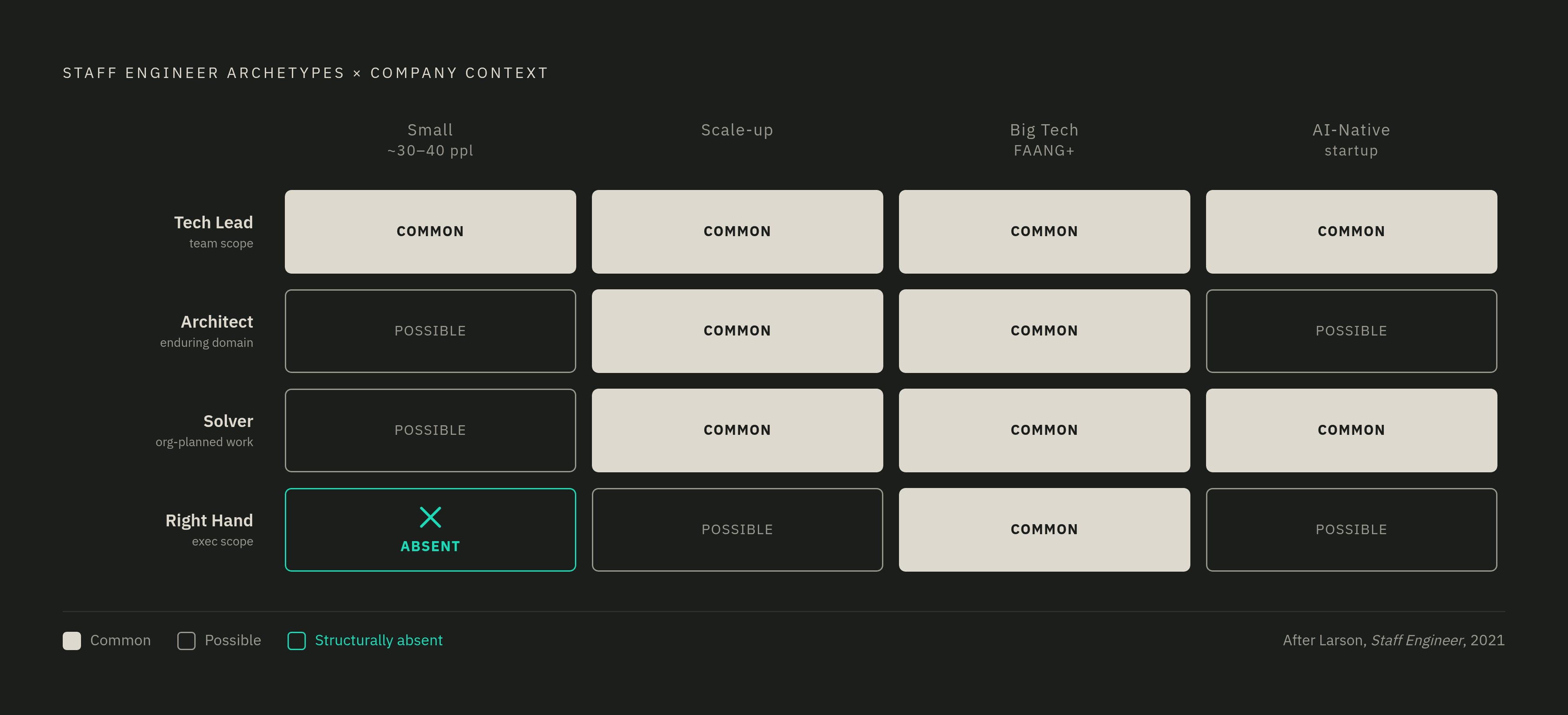
The Right Hand makes the structural constraint easiest to see. An executive needs enough scope to justify a technical proxy, and that proxy needs a clear relationship through which authority can pass. At a 30-person startup, the founder already fills both the executive and senior technical roles. There is no separate layer of work for a Right Hand to occupy. Wanting that job does not create it.
The Architect faces a different constraint. The company needs a technical domain that is both complex and enduringly central. The Solver, meanwhile, fits an organization that plans work around people. The Tech Lead survives across the widest range of environments because the role requires only that a team exist. But leading one team and guiding a cluster of teams are different assignments, even when the title stays put.
Changes in management structure make these distinctions more consequential. Between 2023 and 2025, flattening at a significant number of technology companies pushed strategic work formerly held by directors onto Staff and Principal engineers. When a management layer is cut, its decisions still need to be made. It changes who must make them. Company size alone therefore cannot explain a Staff role.
What Staff Engineer actually looks like at a startup (a small engineering organization)
At a small startup, Staff Engineer usually means a Solver and Tech Lead hybrid. This person guides execution, holds the final technical say on a major service, and gets called when something is on fire. The work can also include ownership of the whole system’s architecture because nobody else holds it. That responsibility comes without a mandate over a stable technical domain.
The title itself may be less settled than the responsibilities. Startups often delay writing a career ladder, so Staff can mean the most senior engineer who was not a founder. Meanwhile, there is no Right Hand role because the founder has no need for someone else to act as a technical proxy. Broad access to leadership is not the same as delegated executive authority.
A useful scope test is how many teams your decisions affect without you in the room. At a 40-person startup, the answer may be all of them because there are only three teams. That reach can resemble Principal scope on paper while saying little about influence in a larger organization. After three-plus years in this hybrid, an engineer may have deep execution and incident authority but few reviewed RFCs, org-wide ADRs, or mentorship trails. Even strong experience can leave an engineer without the evidence the next employer expects.
What Staff Engineer actually looks like at a scale-up (a sizable engineering organization)
At scale-ups, the archetypes are easier to see because teams and domains have clear enough boundaries for each role to have its own work. All four archetypes are possible, but the Architect and the Tech Lead guiding a cluster of teams are the dominant forms. The Tech Lead may partner with one, two, or three managers. The Architect has a domain that will last long enough to need an owner over time. Neither role has to be assembled from whatever the most senior engineer happens to handle.
The Solver still has a place, though it is less often the default. A major migration or platform re-architecture can justify a dedicated troubleshooter. The Right Hand also begins to appear where a CTO’s scope is large enough to require a technical proxy. A large scale-up can support the role without making it common.
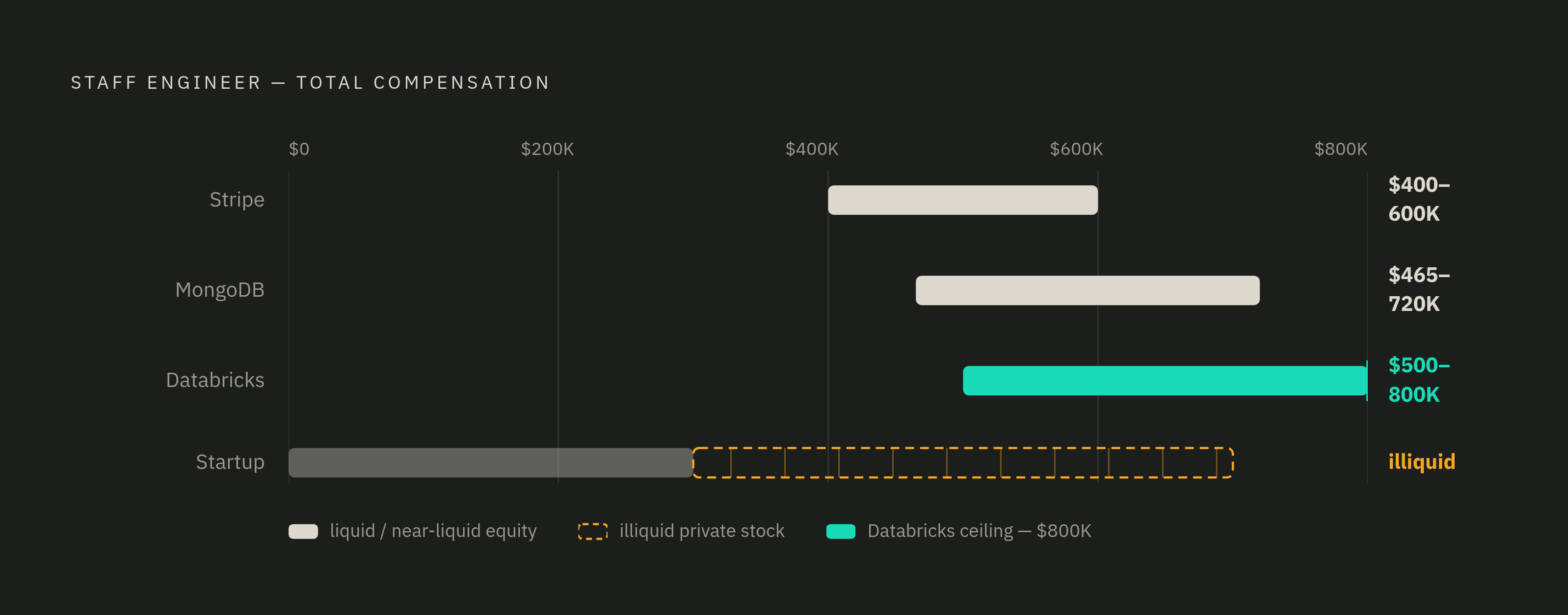
Compensation provides supporting evidence that this is a different job market from the early startup market. Staff-level total compensation is $400–600K at Stripe, $465–720K at MongoDB, and $500–800K at Databricks, and includes liquid or near-liquid equity. Startup offers at the same level can put a large share of pay into illiquid private stock. The comparison therefore involves both organizational scope and the form in which compensation arrives. A shared title settles neither question.
What Staff Engineer actually looks like at big tech (FAANG and adjacent, large engineering organizations)
At big tech, Staff means being a technical leader across several teams in an organization with hundreds or thousands of engineers. Meta E6 has multi-team scope and helps shape where the organization goes. Google L6 is a big step up from L5 into technical leadership. These expectations are explicit and used in calibration across hundreds of teams. Even the Tech Lead archetype therefore operates at a scope many startup Staff roles cannot provide.
Dropbox’s IC5 definition calls for a technical strategy that spans years and teams, carried out by building it directly or leading technical work more broadly. That is a clear expression of Architect work, supported by an organization with enduring domains and multiple teams. The Right Hand also reaches its fullest form here because executive scope, reporting relationships, and institutional authority can support a genuine proxy. Although large scale-ups can provide these conditions, early startups cannot reproduce them just by assigning a title.
Solver work changes too. Big tech can choose senior individual contributors to work on hard cross-org problems rather than wait for someone within a team to step in as a troubleshooter. That makes the work more structured than startup firefighting. It also changes the interview evidence that matters, since technically strong candidates can be downleveled when they describe only what they built themselves. Behavioral answers should include at least one other engineer whose trajectory the candidate influenced.
How the archetype map changes when the company is an AI-native startup
AI-native startups complicate the usual relationship between size and role. Their teams can be small enough for startup norms while technical complexity and customer deployment demands push engineers into Architect and Right Hand behaviors early. This compresses the timeline without necessarily creating the supporting structure. Engineers can be accountable for strategy from day one because the company never created roles like those held by directors.
The Forward-Deployed Engineer, or FDE, shows how these boundaries blur. This engineer embeds with enterprise customers to drive returns from AI and acts as a Solver/Right Hand hybrid. The role borrows the company’s credibility and the customer executive’s scope at the same time. That is close to how a Right Hand works, though it differs from acting as an executive’s proxy inside a big tech company. The Founding Engineer has a different mix of work: getting things done as a Tech Lead, owning the whole system as an Architect, and acting with a Solver’s urgency.
Those combinations can also create mismatched expectations. At xAI, co-founders and senior engineers departed in 2026 amid tensions over demands to ship faster and improve model benchmarks. The case illustrates the risk of asking Solver and Architect profiles to carry Right Hand accountability they did not expect. It makes the boundary between technical ownership and executive accountability a material part of the role.
How title inflation across company types creates a career translation trap
Titles do not translate cleanly because employers attach them to different scope. As a translation pattern, a Meta E5 Senior Engineer can map to Staff at a scale-up such as Stripe or Databricks, or to Staff, Principal, or Founding Engineer at a sub-30-person startup. It shows why the word on the offer cannot establish whether a move increases responsibility.
The trap works in both directions. A startup Staff Engineer may receive a Meta E5 offer because the portfolio lacks the multi-team influence expected at E6. Conversely, a Google L5 engineer taking a Staff offer at a Series B startup can gain a title while accepting a meaningfully lower base and private stock that may not liquidate for years. That trade makes sense only if the Solver or Founding Engineer hybrid is the work the engineer wants next.
Inflated titles can help startups hire when they cannot match cash offers, so a title used to attract engineers can be an unreliable guide to the scope of the work. For engineers comparing these offers, the company-structure distinctions in Fonzi’s research make the missing evidence easier to anticipate before accepting. The practical protection is to separate genuine ownership from a label that another employer may not recognize.
How to identify which archetype a role is actually hiring for before you accept
A job description rarely reveals the whole structure behind a Staff opening. Fonzi offers one way to apply this analysis before interviews, through an AI talent agent that screens for archetype fit against each company’s structure. Its matching process surfaces salary bids upfront, making the compensation-scope trade-off visible before an engineer invests interview time. Direct conversations with the hiring team provide another way to examine that fit. Reading open job descriptions can identify possibilities, but the requirements alone do not establish which role is actually available.
Start those conversations with management layers. Ask whether the company has removed director or group-manager positions. Ask what strategic accountability moved into the Staff role as a result. Then ask what unit the organization plans around. If Jira tickets go mostly to named people rather than teams, the work is likely to fit a Solver whatever the advertised title.
Next, ask who made the most recent org-wide technical decision. If the answer is the CTO or a founding engineer, Architect or Right Hand scope may already be occupied. That changes what the incoming engineer can own. Establishing the available mandate before accepting helps avoid discovering after joining that the promised authority belongs to someone else.
Which archetype to optimize for depending on where you are in your career
The right sequence starts with the career capital you need next. For engineers who want both technical depth and organizational scope, the strongest structural recommendation is a barbell pattern. Early years in big tech or a well-funded scale-up build cross-team RFCs, adopted standards, and mentorship trails that translate across employers. Later years at a well-chosen growth-stage startup trade that foundation for Solver and Founding Engineer experience that cannot be replicated at scale. The company type follows the intended work.
Engineers already in a startup Solver/Tech Lead hybrid face a different task before seeking Staff roles at larger companies. Audit the portfolio for adopted design documents that address dissent, mentorship with documented outcomes, and at least one decision that visibly changed a team’s trajectory. Engineers moving out of big tech should instead name what draws them toward a startup. If it is hard problems, speed, and individual planning, an AI-native startup in the seed-to-Series A range fits that preference. If it is Architect work at scale, a growth-stage scale-up preserves more of the familiar scope.
The Right Hand path requires particular care because it grows from an executive relationship. Ask explicitly about that relationship and organizational size before accepting a role that promises it. Timing matters financially too, since the Staff-to-Principal transition can bring a 25–35% increase in total compensation. But the next offer should first answer a more basic question, namely which kind of authority and experience the job makes possible. The archetype is the most important structural choice a Staff-level engineer makes.